Banana Peels Really Help Plants Grow? What Garden Experts Want You to Know
You have probably seen the gardening trick everywhere: save your banana peels, put them in water or bury them in the soil, and give your plants a natural boost of potassium.
It sounds simple, inexpensive, and completely natural.
But are banana peels actually good for plants?
The short answer is yes—but not in the way many social-media gardening videos suggest.
Banana peels contain potassium and other nutrients, but placing fresh peels directly into your plant’s soil is not the most effective way to feed your plants. Gardening experts recommend composting banana peels first rather than relying on raw peels as a direct fertilizer.
Let’s look at what banana peels can really do for your plants—and the mistakes you should avoid.
Are Banana Peels Good for Plants?
Banana peels contain potassium, a nutrient plants need for healthy growth and flowering. However, that doesn’t mean a fresh banana peel works like a complete fertilizer.
Plants require several essential nutrients, including nitrogen (N), phosphorus (P), and potassium (K), along with other nutrients. A banana peel cannot provide balanced nutrition by itself.
According to the University of California Agriculture and Natural Resources, banana peels can eventually contribute potassium, but decomposition takes time. During decomposition, microorganisms require nitrogen, potentially reducing the nitrogen available to plants.
So, while the idea isn’t completely wrong, the popular “bury a banana peel and watch your plant explode with growth” claim is misleading.
What Does Potassium Do for Plants?
Potassium is one of the three primary nutrients found in conventional N-P-K fertilizers.
It plays an important role in plant growth and is particularly associated with processes such as water regulation, overall plant development, and flowering and fruit production.
Banana peels contain potassium, which is why gardeners have traditionally used them as a homemade fertilizer ingredient. However, the important question is how that potassium becomes available to the plant.
A fresh peel sitting in potting soil does not instantly release its nutrients.
It must first decompose.
Should You Bury Banana Peels Directly in the Soil?
Generally, no.
This is one of the most common banana-peel gardening mistakes.
Fresh banana peels can take considerable time to break down. During decomposition, microorganisms use nitrogen, potentially creating what gardeners call nitrogen drawdown. That can temporarily reduce the nitrogen available to growing plants.
There is another problem: decomposing food scraps near the soil surface can attract unwanted animals and pests.
University of California gardening experts specifically recommend putting banana peels into the compost pile instead of directly into the soil.
So if you have a banana peel in your kitchen, don’t throw it into your plant pot.
Put it in your compost instead.
What About Banana Peel Water?
This is another popular homemade fertilizer.
The basic idea is to soak banana peels in water for several days and then use the liquid to water plants.
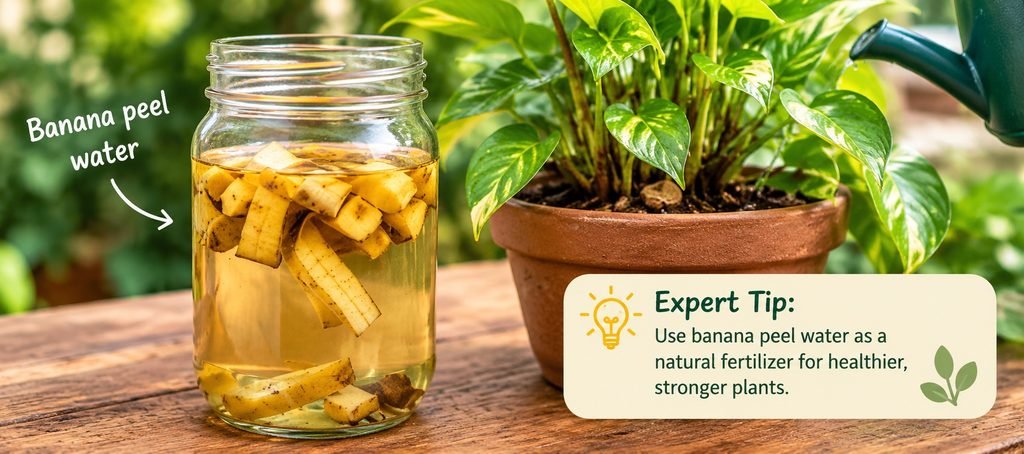
There is some logic behind the method because potassium is water-soluble and can move into the soaking water. However, this does not turn banana water into a complete fertilizer. Other nutrients in the peel may remain largely in the solid material rather than moving into the water.
That means banana peel water should not be treated as a magical replacement for balanced plant fertilizer.
If your plant genuinely needs potassium, using a fertilizer formulated with a known nutrient concentration is much more predictable.
The Best Way to Use Banana Peels for Plants
If you want to recycle banana peels in your garden, composting is the better option.
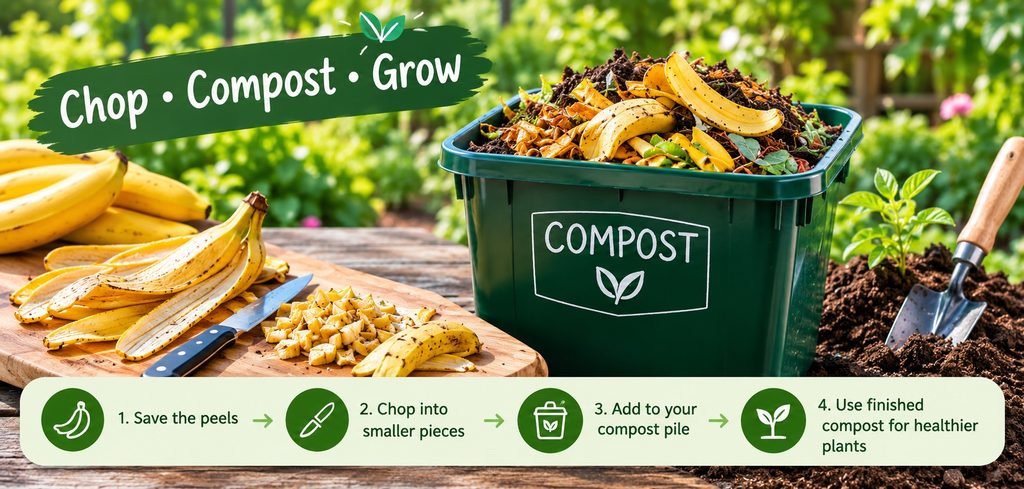
Step 1: Save the peels
Instead of throwing banana skins into the trash, add them to your compost collection.
Step 2: Chop them into smaller pieces
Cutting the peels into smaller pieces can help them break down more easily.
Step 3: Add them to your compost
Combine banana peels with other appropriate compost materials rather than using them alone.
Step 4: Let the compost mature
Allow the organic material to decompose properly before using the finished compost around your plants.
Step 5: Use finished compost around plants
Finished compost provides organic matter and a broader mixture of nutrients than a raw banana peel.
University of California experts recommend composting banana peels and then using the resulting compost rather than burying fresh peels around plants.
Can Banana Peels Replace Fertilizer?
No.
This is probably the most important thing to remember.
Banana peels can be a useful ingredient in compost, but they should not be considered a complete fertilizer.
Plants need a balanced supply of nutrients, and their requirements vary depending on the plant, growth stage, soil, and growing conditions.
For example, plants grown for flowers or fruit may have different nutrient requirements from leafy vegetables or houseplants.
If you suspect a nutrient deficiency, it is better to identify the problem and use an appropriate fertilizer rather than adding random kitchen scraps.
University of California gardening guidance recommends using fertilizer when it is actually needed and considering soil testing when nutrient deficiencies are suspected.
Which Plants Can Benefit From Compost Made With Banana Peels?
Finished compost containing banana peels can be incorporated into many garden soils and container-growing systems, provided the compost is properly matured.
It can be particularly useful as part of a broader soil-improvement strategy for:
- Flowering plants
- Vegetable gardens
- Herbs
- Fruit plants
- Ornamental plants
- Outdoor container plants
But remember: the benefit comes from the finished compost and improved soil environment—not from placing a raw banana peel next to the roots.
Common Banana Peel Gardening Mistakes
Before trying this popular gardening hack, avoid these mistakes:
❌ Burying fresh banana peels in a plant pot: This can encourage decomposition problems and attract pests.
❌ Expecting instant potassium: Nutrients are not immediately available from a fresh peel.
❌ Using banana peel water as complete fertilizer: It does not provide balanced plant nutrition.
❌ Using banana peels instead of proper fertilizer: Plants require more than potassium.
❌ Adding too much kitchen waste directly to soil: Compost food scraps properly first.
So, Are Banana Peels Actually Worth Using?
Yes—but use them as compost material, not as a miracle fertilizer.
Banana peels contain useful nutrients, particularly potassium, but fresh peels are not an efficient or balanced plant food. They need to decompose before their nutrients become useful to the soil, and the decomposition process can temporarily compete for nitrogen.
If you want to recycle banana peels, the smartest approach is simple:
Eat the banana → save the peel → compost it → use the finished compost to improve your soil.
That’s a much more reliable gardening practice than burying a fresh peel beside your favorite plant.
Final Verdict
Are banana peels good for plants?
Yes, but mostly as a compost ingredient—not as a direct fertilizer.
Banana peels contain potassium, but plants need a balanced supply of nutrients. Fresh peels can take time to decompose and may temporarily tie up nitrogen during decomposition. They can also attract unwanted pests when left in the soil.
For healthier plants, focus on good-quality soil, appropriate watering, adequate light, finished compost, and fertilizer when your plants actually need it.
So the next time you finish a banana, don’t put the peel straight into your plant pot.
Put it in the compost bin instead. Your plants—and your soil—will benefit more in the long run.